
Hoodoo, Representation, and Repression
One Rootworker's Review of Coogler's Sinners
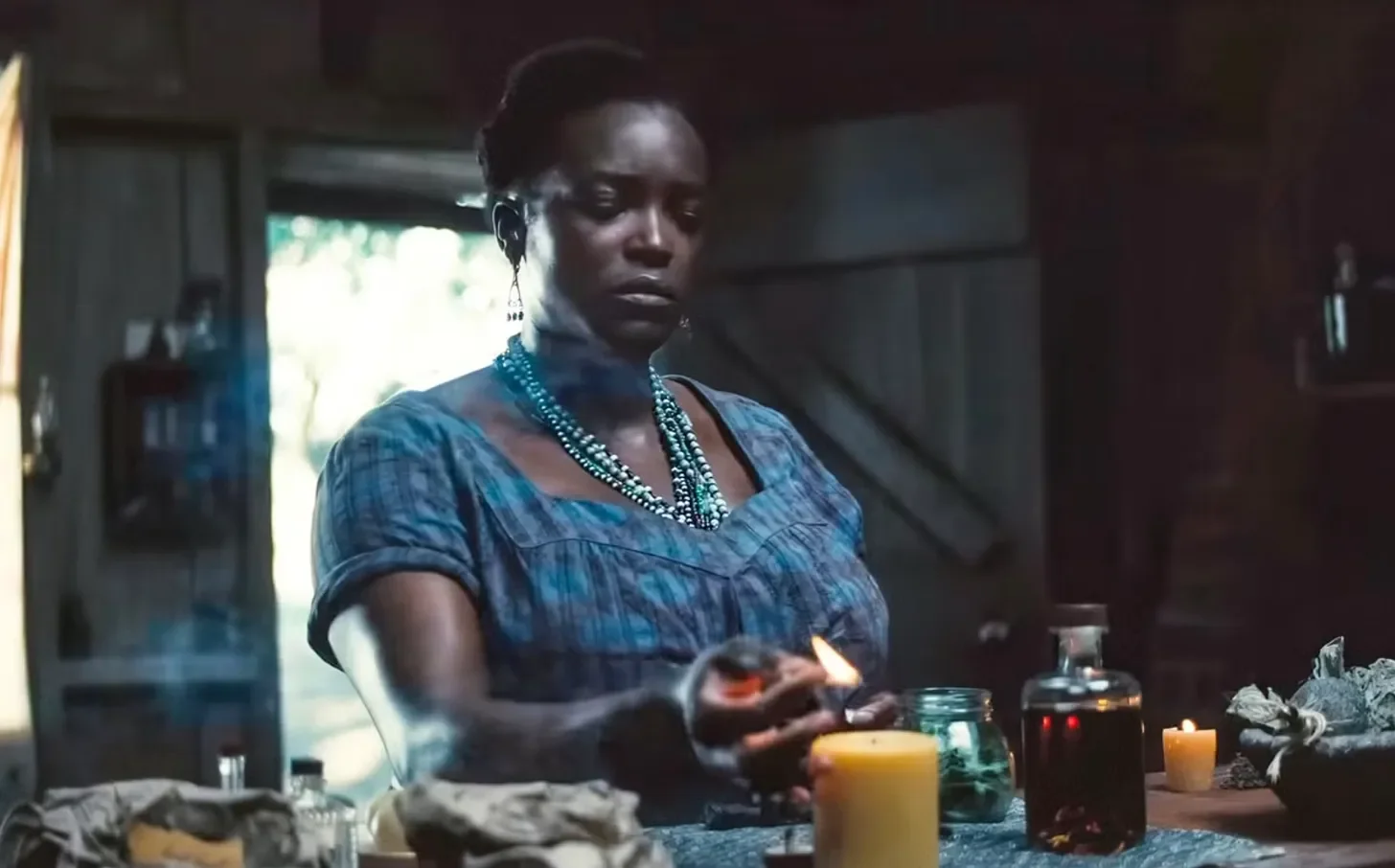
Still from Sinners, Warner Bros. Films 2025
Annie from Sinners is the best representation of Hoodoo on screen this decade.
Wunmi Mosaku infuses her character with the strength of spirit, compassion, and community-mindedness I hope to see in any conjure woman. She also brings the full force of her classical training to bear on a script where all three women leads are underwritten.
Were it left to another actress, Annie’s subtextual contours — those expressions of willingness, fear, resistance, and ultimately, resignation to the dominion of destiny — may have been lost.
Mosaku’s Annie holds a mix of spiritual power and political disempowerment. It’s clear that her work works – though why she doesn’t apply it to herself, or to the new juke joint, I can’t say. The script, too, disempowers Annie, whose role holds no medicinal aspect. Though wounds are a constant throughout the film, from the bullet holes that get us started to what comes later, Annie does not doctor them.
In “Conjuring in the Big House Kitchen: An Interpretation of African American Belief Systems Based on the Uses of Archaeology and Folklore Sources,” Leone and Fry define rootwork as “partly healing, partly the seeking of good luck or the curing of bad.” While not all conjure is rootwork, nor is all rootwork conjure, themes of illness, healing, wellness, and protection are present in both.
Thinking of a conjure woman and a root doctor as inherently separate things is a newer concept, as Hazzard-Donald explains in Mojo Workin’: The Old African American Hoodoo System, writing “Even African Americans who know anything of contemporary Hoodoo will usually not immediately associate it with medicinal herbalism. Hoodoo marketeers were neither interested in nor had access to this aspect of Hoodoo (p. 202).
There were many places in Sinners that could have benefited from even the most basic medical care. While it’s certainly common now to meet a conjure woman with no knowledge or training in medicinal rootwork, the period in which Sinners takes place means Annie probably would have.
While we don’t know how wide Annie’s network of other conjure doctors and two heads is, the film leaves us to assume that she may be the sole provider for her immediate community – or The Lady as such a person is sometimes called, as in “you should go see The Lady,” or “I’m going to The Lady to see if he’s coming back.”
Yet that puts Annie in a position of still more authority. If she was, as Coogler positioned her, in a position of care for all those sharecroppers, she would have needed to fill many roles. Conjure doctors, rootworkers, and granny midwives (who often fell into the previous categories as well,) birthed babies, healed the sick, counseled communities, removed and affixed all manner of work.
Still, Sinners is easily among the best and freshest movies I’ve seen in this century, though the inaccuracies around Hoodoo embedded in the movie, some of them which will be quite obvious to those who know, complicate my overall pleasure as a viewer.
Sinners is, no doubt, good representation overall, sometimes even groundbreaking. The assertion that Black life and death, joy and terror live perpetually side by side – as twins even – is enough for me to recommend the film.
The film will almost certainly drive greater interest in Hoodoo, which is a net good in a country that undervalues Black people and our religious heritages. That said, like Smoke and Stack, like joy and terror, like life and death, representation has two sides.
The more aware of Hoodoo the general viewing public becomes, the wider repression the tradition will likely face.
It’s happened before. In fact, the places and times in which people were most familiar with these traditions were when they saw legal repression, some of which exists to this day.
I am among the inheritors of a long tradition of doctoring. It is illegal for me to say that plain.
It’s an illegality that many two-headed doctors, conjure doctors, and root doctors navigate in different ways. Some don’t care.
For others, like myself, the threat of being sued for practicing medicine without a license requires constant mindfulness about my language. After all, many clinical herbalists register with the American Herbalist Guild, a source of support, standardization, and surveillance.
Quiet though it’s kept, much of the history of professional licensure in the United States was designed to interrupt what Black people, particularly Black women, were already doing.
“Plantation practitioners endured abuse and violence to share their skills and provide relief to the slave community,” Ralph Crowder wrote in 1980’s “Black Physicians and the African Contribution to Medicine.”
It’s fair to presume that such abuse was widespread. Legislation against Black doctoring traditions began over one hundred years before the American Civil War. “Laws enacted by the Virginia legislature as early as 1748 determined that enslaved people administering medicines without approval by their enslaver was an act punishable by death,” the staff of Philadelphia’s Mutter Museum recounts, referencing Covey’s African American Slave Medicine in their blog post “Medicinal Practices of Enslaved Peoples.”
Even beyond that, the tradition itself, once put under the scrutiny of outside eyes was criminalized in and of itself.
Shobana Shankar’s historical work about incarcerated women in 1930s Mississippi, the period in which Sinners is set, has this to say in “Parchman Women Write the Blues? What Became of Black Women's Prison Music in Mississippi in the 1930s” :
[Coen] viewed “hoodoo as quintessentially criminal, a shift in perception that reflected the rapidly increasing rates of black incarceration in the Jim Crow era. Parchman [Prison] women told him about lovers’ quarrels and the use of hoodoo, but even in such seemingly obvious cases of criminality, hoodoo provided an alternate means of redress through bodies, not just harm understood in the white criminal justice system.”
They even took Dr. Buzzard to court for “practicing medicine without a license,” though I’m sure they regretted it once their key witness fell out on the stand.

Still from Sinners, Warner Bros Films, 2025
While some omissions, oversights, and inaccuracies in Sinners bother me more than others, I’ve come to the conclusion that inaccuracies in popular fiction about hoodoo may be a double edged sword. They can allow us to keep our secrets secret, and may act as a sort of gatekeeping.
The renewed popular interest in Hoodoo of the last ten or so years concealed the fact that many of us who practice in public were trained up in the home, then undertook years of study under elders as apprentices, mentees, and students.
It’s not a tradition you pick up one day because you saw a movie, or liked a song. Those may be entry points, of course, we all start somewhere. Yet because a single work of art could never capture the total depth and breadth of Hoodoo as a tradition, nor should it, some things are better left to other kinds of griots.

Hey, I’m Cyrée
I’m a rootworker, diviner, and clinical herbalist. I believe that spirit work is an essential part of all movements for justice. I hope you’ll take a look around, there are plenty of opportunities here to deepen your connection with your gifts (with my guidance.)
Here's how to activate the Ace of Pentacles to find some stability in a soul sucking world.