
The Church House is On Fire
Is there anything you want to keep?
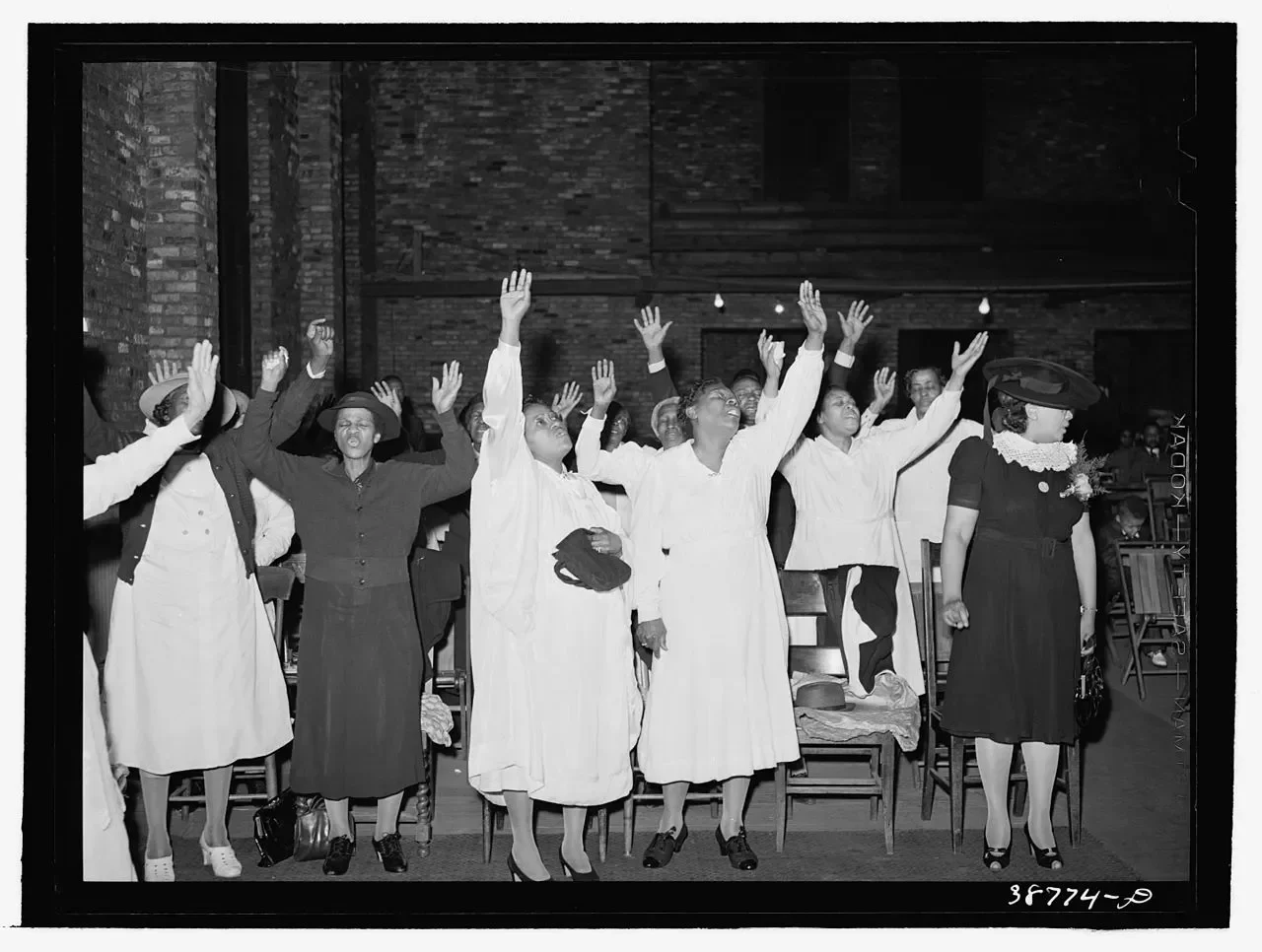
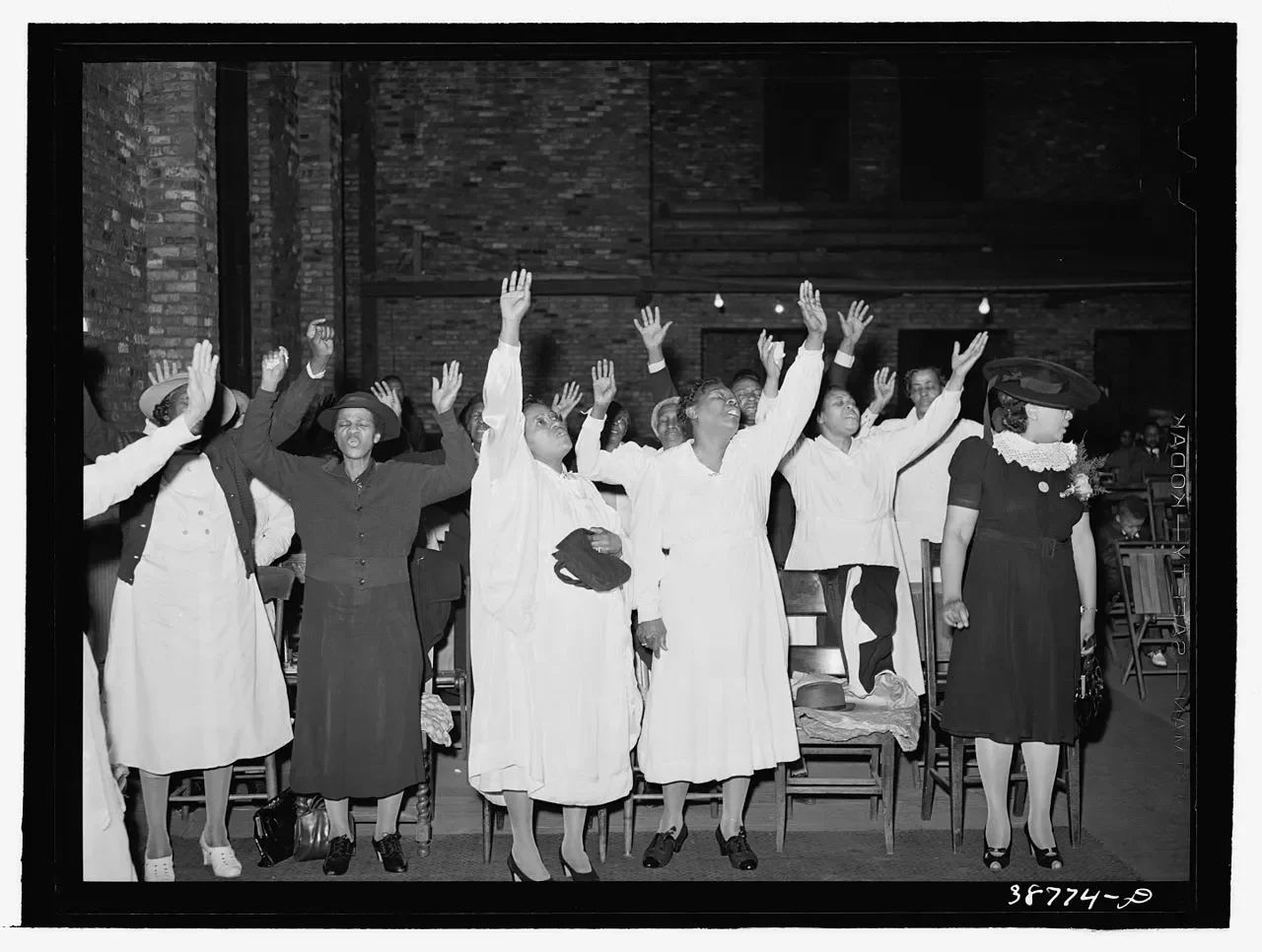
Russell Lee, “Members of the Pentecostal church praising the Lord. Chicago, Illinois,” negative, April 1941, Library of Congress Prints and Photographs Division, Washington, D.C. Call #LC-USF34- 038774-D. Digital Reproduction #LC-DIG-fsa-8c00864.
Thirty-three percent of Black millennials are "religiously unaffiliated." Of those that left the Black church, church hurt is often the reason.
It’s the mix of shame, pain, and stigma that comes from the way the leadership and laypeople of the Black church have betrayed younger generations, and multiply marginalized Black people.
Sixty-nine percent of Black millennials grew up in the Black church, referred to hereafter as "The Church."
Not so long ago, eighty percent of Black churchgoers belonged to three traditions within Christendom. Those traditions are Pentecostal, Baptist, and Methodist.
I grew up in a African Methodist Episcopalian family, and we all felt a little snooty about that. I grew up seeing Black Jesus in my church, and if I saw otherwise when we visited other churches, I pitied them.
White Jesus looked so skinny and broke down to me, a real wuss.
The Black Jesus of my childhood looked like he could come down off the cross if he wanted. He looked like he could flip those table in the temple.
It made his sacrifice all the more Godlike. Black Christians preserved the god in Jesus. It helped me see the god in myself.
Like seventy-six percent of current Black churchgoers, my church spoke in tongues, participated with the preacher, and of course, caught the spirit.
One thing that's not said enough is that most of a church service in a Black church is intended to provoke spirit possession. It's not an incidental or accidental part of the service. This living display of holy ghost power is the reason we are there.
I say this because there are positions in the Black church that are available for this explicit purpose: the church nurse.
My grandmother was a church nurse. Her work was so normalized in my community, it took me much of my life to understand what she was doing. I won't recount it here, because if you've seen them you either know what you saw or you don't.

My grandmother disclaiming her own spiritual ability in the face of my own, her daughter's, and her mother's. Yet she was the first person to explicitly tell me that there was Hoodoo in my family.
This happened before my gifts had ever presented. She was also my sunday school teacher, and as such, produced the church's holiday plays.
Naturally, Easter was her time to shine. She sang one of the crucification solos, she was the premier creator of palm crosses. She wrote the date on the back in her flamboyant script in blue ink Easter 2008. If I was absent--in college or grown, since skipping church was never an option prior to that--she'd mail it.
When my grandmother put on her all whites, covered her head in a white hat, and threw a white blanket over the spirit slain, what did she think of it? How should I think of it as a churchy hoodoo who the church left?
My mother is in the third act of a longtime war with the truth, so I hesitate to take her stories as fact. That said, it is my understanding that church leadership at my grandmother's church kicked her out for being gay.
I couldn't have been older than six when it happened. Even this did not spare me a day of church with my grandmother.
Nor did it end my mother's relationship with church overall. I grew up, alongside my time in AME church, in the Unity Fellowship Church Movement. It's Black, LGBTQ (same-gender loving at the time), and not like, explicitly Christian.
My pastor was a soft stud, we poured libations, like the AME church there was plenty of ululation in the presence of god. It was a beautiful environment and a long day.
Church started in the afternoon, so I could go to both churches in a day, and sometimes did.

It was my mother's removal from the church, and my subsequent isolation from it, that helped me see it for the high control environment it can be.
A high control environment is a place that has all the answers. They know exactly how you should think, feel, and act. They will create and enforce those norms. There's often an aspect of free labor, and control often includes misogyny, homophobia, etc.
Many, if not most, churches can become high control environments. Yet they are not the only HCEs around. All groups need to ensure that they don't become HCEs.
As a child of the working class, my family was often dependent on the church. We ate from their food pantry. I got bags of hand-me-down clothes from somebody or another's granddaughter.
The church housed and subsidized the extracurriculars that later informed my career path. I am someone The Church, the Black church, made.

The Hoodoo revival, or renaissance as I've sometimes seen it called, has a complex relationship with churchy hoodoos. To get to deep into that would mean to speak on the work of individuals within the tradition. I have no intention of doing that here.
What I will say, however, is that it sometimes comes across as resentment for those of us who grew up with Hoodoo. When it doesn't, it comes across as a deep down church hurt. Honestly, I'm not mad about either.
It makes sense to hate the church. I would love to hate it too. Hate it for making me think there was something wrong with me. For putting me in situation where violence towards me was something I simply needed to endure.
I struggle to conjure those feelings, that rage, because I don't know that the places I've found myself after are any less high control environments than the church was.
I see the same normalization of misogyny. I see lots of elders who disrespect queer and trans people. I see the same rape culture. I see the jockeying for power and control that people normalize until they say they always saw it.
I've experienced this in painful ways myself. We have our own Eddie Longs and Juanita Bynums. We have our own toxic norms and profit-driven behaviors.
Thinking of myself as a churchy hoodoo helps me see some of those patterns within my own tradition. And if the Pew Center for Research is to be believed, many of us within this tradition are also coming out of the church.

The church house is on fire. It's up to us what we want to save.
Only five percent of Black Americans in the silent generation were religiously unaffiliated. This is a choice my generation is making, and I believe it is a good one.
Yet there is history, favor, and power in the history of The Church. There's a reason we work the psalms. There's a reason we shout, sing, and move like we do.
We remembered even when some of us couldn't remember what we were remembering.
The church house is on fire. Is there anything you want to keep? Is there anything you'll run in to save? Is there anything you'll hold in your heart as it's rendered to ashes completely?
And how can we be sure that we won't make it again with the face of some other god on the fans?
Church hurt can make some folks think that those same problems outside of the church are better than experiencing them within the church.
I want them to go away for everyone, forever. The more it's presumed that the church possessed within it some unique evil, the less we work to root out the evil where we live now.
Church hurt can't be ignored, it's corrosive. It colors how Hoodoo's complex and multifaceted history is passed, spoken, and learned.
It compels people whose grandmothers spoke in tongues and laid hands to say they grew up without a trace of Hoodoo. It neglects the reality of what Hazzard-Donald called in Mojo Workin' "The Hoodooized Christianity (144)."
When the early bishops of The Church tried to root out these practices, they failed, and with wider conversion, failed worse. We kept what made us Black in the face and under the nose of White Christendom.
When I looked at the Pew Research, I found that sixty-one percent of Black Americans "believe evil spirits can cause problems." Between thirty-three and forty percent of us know that "prayers to ancestors can protect them."
Every day since we found ourselves on these cursed shores has been a Hoodoo renaissance. Every day has been a testament to the brilliance of our ancestors. Every day has been a testament to our will to survive.
We shouldn't be ashamed of what that survival entailed. We should step up, and change what the future looks like instead.

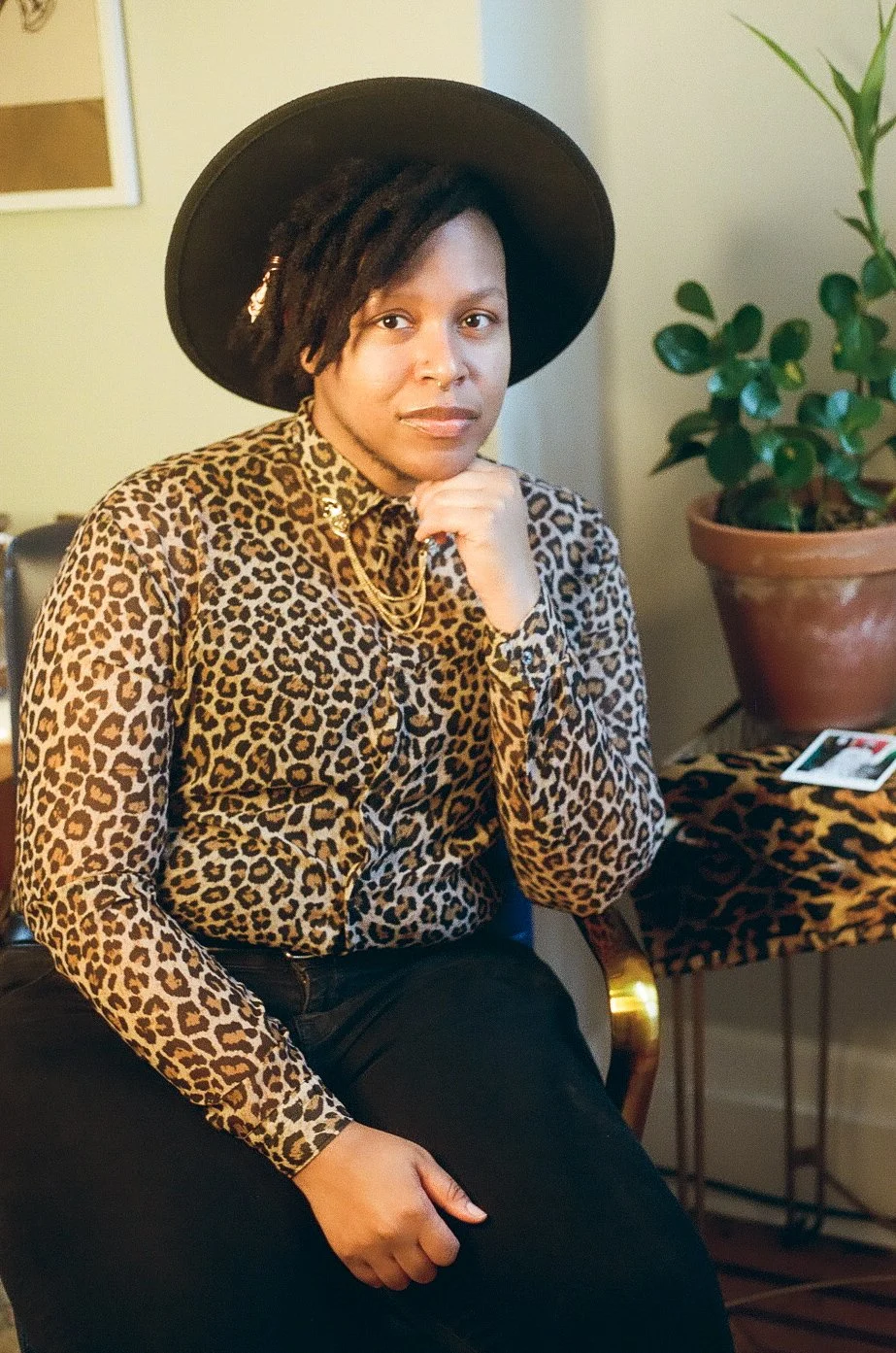
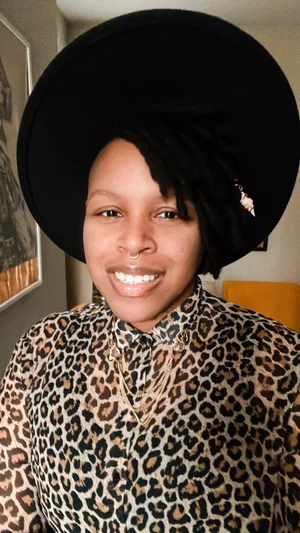
Hey, I’m Cyrée
I’m a rootworker, diviner, and clinical herbalist. I believe that spirit work is an essential part of all movements for justice. I hope you’ll take a look around, there are plenty of opportunities here to deepen your connection with your gifts (with my guidance.)
Here's how to activate the Ace of Pentacles to find some stability in a soul sucking world.