
What is a Rootworker?
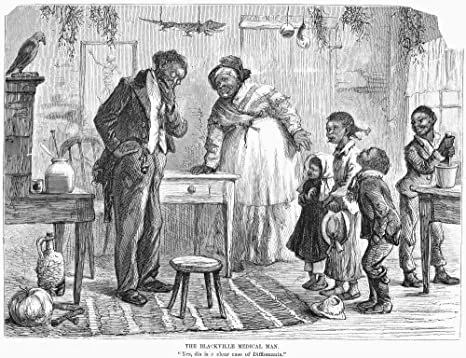
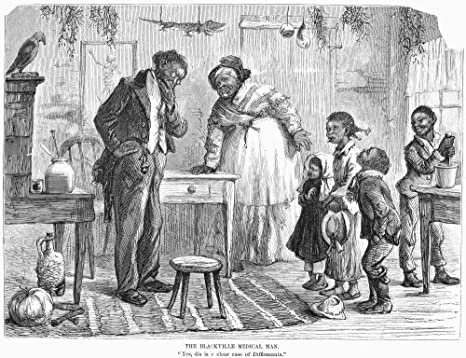
Depiction of a Root Doctor in the American South, captioned “The Blackville Medicine Man.” Original artist unknown. Via Wikimedia Commons.
A rootworker is a Hoodoo practitioner trained to work with plant spirits to transform material, spiritual, and emotional conditions.
Some rootworkers focus on plant medicine, and the herbalist lineage within Hoodoo tradition. Others focus on the magical and spiritual aspects of rootwork and conjure to primarily transform spiritual conditions impacting personal success and vitality.
Rootworkers, like other gifted practitioners within Hoodoo, are often trained through apprenticeships with other rootworkers and conjure doctors. This training may come through family or a rootworker’s community. Training could also come from a prominent elder practitioner within the Hoodoo community.
Though a medicinal rootworker may look the same as a clinical or community herbalist to the untrained eye, there are important differences between the work of most rootworkers and that of an herbalist working in another tradition.
This article will address the role of a rootwork within Hoodoo, how someone becomes a rootworker, and the differences between a rootworker in Hoodoo and herbalists working in more mainline herbal traditions.
I’ll discuss:
✹ What a rootworker is
✹ What a rootworker does
✹ The difference between rootwork and western herbalism
Jump to Section:
⟶ How is a Rootworker Trained?
⟶ What is the Difference Between an Herbalist and a Rootworker?
What is Rootwork?
Rootwork is a system by which Hoodoo practitioners work together with plant spirits, holy places, spiritual tools, elevated and ancestral spirits, earthly signs, and other factors to transform spiritual, material, and emotional conditions in a person’s or community’s life.
Rootwork is sometimes used as another name for the entire Hoodoo tradition. According to Dr. Katrina Hazzard-Donald in her book Mojo Workin': The Old African American Hoodoo System, “Hoodoo is the indigenous, herbal, healing, and supernatural-controlling spiritual folk tradition of the African American in the United States (p. 15).”
Taken in this way, rootwork is the measure of the herbal and supernatural healing aspects of Hoodoo tradition.
Sources that insist rootworking traditions among African Americans are of blended origin with European folk herbalism traditions are incorrect. Rootwork within Hoodoo is a blend of African approaches to plant medicine and magic that enslaved Africans brought to the so-called United States through the middle passage.
As I am trained in both Hoodoo rootwork and Wise Woman herbalism, I feel qualified to piece apart the vast differences between the two traditions, and assert fully that the former was more of an influence to the latter than vice versa.
What Does a Rootworker Do?
A rootworker works one-on-one with clients, couples, and communities to seek justice, increase wellbeing, enact change through ritual, remove issues of a spiritual, material, and/or emotional nature, conjure abundance, protect against harm, and promote natural balance among many other things.
Rootworkers do their work within communities, and it is essential that a rootworker be a trusted member of the community themselves. Under enslavement, rootworker provided health and wellness care not only for enslaved Africans but often for everyone on a plantation and in the community in which the plantation stood. This could include delivering enslaved women’s babies, delivering the babies of their slavers, and being an essential source of health care for enslaved Black people and poor white people alike.
According to Herbert Covey’s book African American Slave Medicine, European medicine during the time of enslavement consisted of bloodletting, homeopathy, and surgery to an unhelpful degree. Before the professionalization of medicine in the United States, which in many cases coincided with bans on rootwork and rootworkers, sometimes on pain of death, the Black American rootworking system was more advanced and skillful than what white physicians had to offer.
This was particularly true in their approach to treating enslaved people. As Covey writes, “White physicians relied heavily on sugarcoated pills based on the premise that slaves were inclined to place more confidence in tasteful remedies.” They even went so far as to call these quack medications “nigger pills.”
These “medicines” often made enslaved people sicker. As Rebecca Fletcher, a formerly enslaved woman whose words are recounted in African AmericanSlave Medicine, recalled “Old missis used to give us blue mass pills when we needed medicine. It sho did make us sick. We had to get sick to get well, old missis said (p. 11).”
The role of the rootworker then, as now, is to ensure the physical, spiritual, and emotional wellness, prosperity, equity, protection, and vitality of the entire Black community.
In more recent times (though enslavement is not so far behind us as the United States would like to portray,) a rootworker meets with their client or clients to understand their health and wellness goals and journey, consults with signs, spirits, and spiritual work including divination and conjure work to help enact meaningful and long-lasting transformation in their conditions and their lives.
This could look like the creation of custom herbal medicine, the setting of lights, the creation of curios, the distribution of standard or practitioner-specific herbal formulas, or the creation of mojo hands. In all things, a rootworker consults with their own ancestors as well as their client’s spirits to find a just resolution to the issues at hand.
How is a Rootworker Trained?
One becomes a rootworker by training with a living rootworker, very often via an apprenticeship.
While I know that some people are going to come at me for saying this, and while I do believe that there are certain foundational principles that one can learn from one’s ancestors of blood and lineage, a connection with a living elder rootworker is essential for becoming a rootworker.
This is because Hoodoo is not a solitary tradition. It happens in community, and thus it is important that someone other than the dead can testify to (and when needed, correct) your technique, ethics, or underlying character.
Apprenticeship and training connects rootworkers with a larger lineage of practice—and that lineage is a major part of what makes works in Hoodoo work.
This apprenticeship may be informal or extremely formal. One may be apprenticed to a family member who does not practice for the general public. One may be apprenticed to a friend who has been in the practice longer. Generally, an apprenticeship comes one of two ways: either a family member is qualified to impart and pass on a family tradition of practice, or a rootworker hears the call, and shows signs of an inherent gift, then seeks out or finds an elder practitioner under whom to study.
The length of a rootworker’s apprenticeship varies widely. For some people it may last years, even decades for those who begin practice as a child, for others it could be only months. In my personal opinion, the ongoing connection between a mentor and apprentice matters more than the intensive time spent together.
What is the Difference Between an Herbalist and a Rootworker?
As I said earlier, while a rootworker may look like an herbalist from the outside, rootwork goes beyond herbalism.
Now don’t get me wrong: a rootworker may (and probably should) also be a medicinal herbalist. Yet the work of a rootworker goes far beyond that of an herbalist.
As a clinical herbalist, I’m able to read blood tests, understand how body systems work together and how herbal properties and components change the body. Yet as a rootworker, I do all of that, while divining with spirits to find the root causes of imbalance, bring balance to conditions with both spiritual and physical natures, and help clients create and undertake rituals to improve their lives in the long term.
My work as a rootworker is in excess of my work as an herbalist. It is more complex than my work as an herbalist and goes far beyond the purview of most herbalists.
This is why it’s inaccurate to say that European herbalism had any part in the creation of rootwork—because European herbalism is a much smaller and simpler tradition than rootwork. A herbalist working in the traditions of European herbalism that would have found their way to the so-called United States (specifically Dutch, Irish, Welsh, and English) could never do what a rootworker does.
The rootworker is the (literal) descendant of the Nganga, the Dibia, and other ritual workers in the African cultures from which we were trafficked. We know this to be true because of the vast syncretisms and similarities between how we do our work and how our cousins on the continent do their work to this very day.
So while herbalism is certainly part of rootwork, it’s not all of it by any means.
Works Cited
Chireau, Yvonne, “What is Hoodoo?” academichoodoo.com. Accessed April 8, 2026.
Covey, Herbert C. African American Slave Medicine, Lexington Books, Lanham, MD, 2008.
Global Faith Ministries of Chiism, “Dibia-Holistic and Spiritual Practice,” Accessed April 8, 2026.
Hazzard-Donald, Katrina. Mojo Workin': The Old African American Hoodoo System. University of Illinois Press, 2012.
Hylton, Raymond Pierre, “Middle Passage to American Slavery,” 2022, EBSCO.com. Accessed April 8, 2026.
Johnson, Cyree Jarelle, “About,” 2024. Accessed April 8, 2026.
Johnson, Cyree Jarelle, “Divination Versus Fortune Telling,” 2018. Accessed April 8, 2026.
Lowcountry Digital History Initiative, “Hidden Voices: Enslaved Women in the Lowcountry and U.S. South,” Accessed April 8, 2026.
IKARA IBOGA RETREAT, “Nganga. Servant to God.” Accessed April 8, 2026.
Wanna Work w/ Me? 👇🏽
Further Thoughts

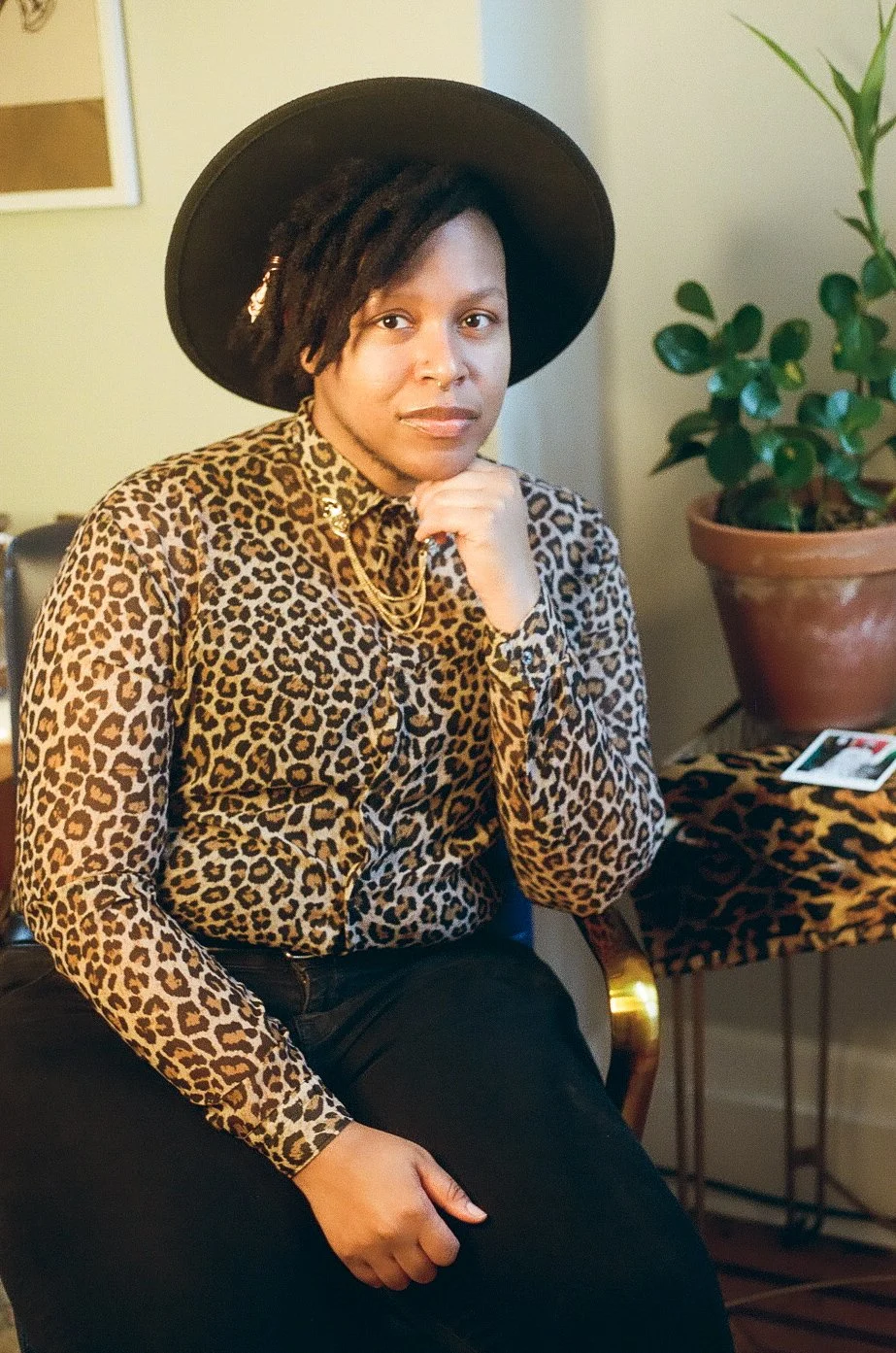
Hey, I’m Cyrée
I’m a rootworker, diviner, and clinical herbalist. I believe that spirit work is an essential part of all movements for justice. I hope you’ll take a look around, there are plenty of opportunities here to deepen your connection with your gifts (with my guidance.)
New to Hoodoo cartomancy and don’t know where to start? Here are the card meanings I suggest for all fifty-four playing cards as a professional card reader!